Ask your data. Get the answer — with the evidence
Natural-language access to SDMX data: find the right dataset, filter it, and get answers, data-grids, SQL and charts in seconds — no SDMX skills or data-engineering backlog required.
The model never guesses the data — AKX finds it, SXS serves it, DuckDB computes it; the LLM only explains the result.
Overview
An SDMX assistant that shows its work
Plain language in
Express queries like “tourism nights by region since 2015” to automatically fetch, filter and chart the exact SDMX dataflow series needed.
Answers, not black boxes
Grounded in real AKX/SXS dataflows. Every response shows the underlying SQL alongside the final visualisation, for complete auditability.
Open & model-agnostic
Swap LLMs through an adapter without touching the app. Behaviour, tone and rules live in a plain-text INSTRUCTIONS.md — no hidden prompts, no lock-in.
Operational from day one
Full real-time telemetry for per-call latency, token usage, cost and tool analytics.
In action
From a question to a chart
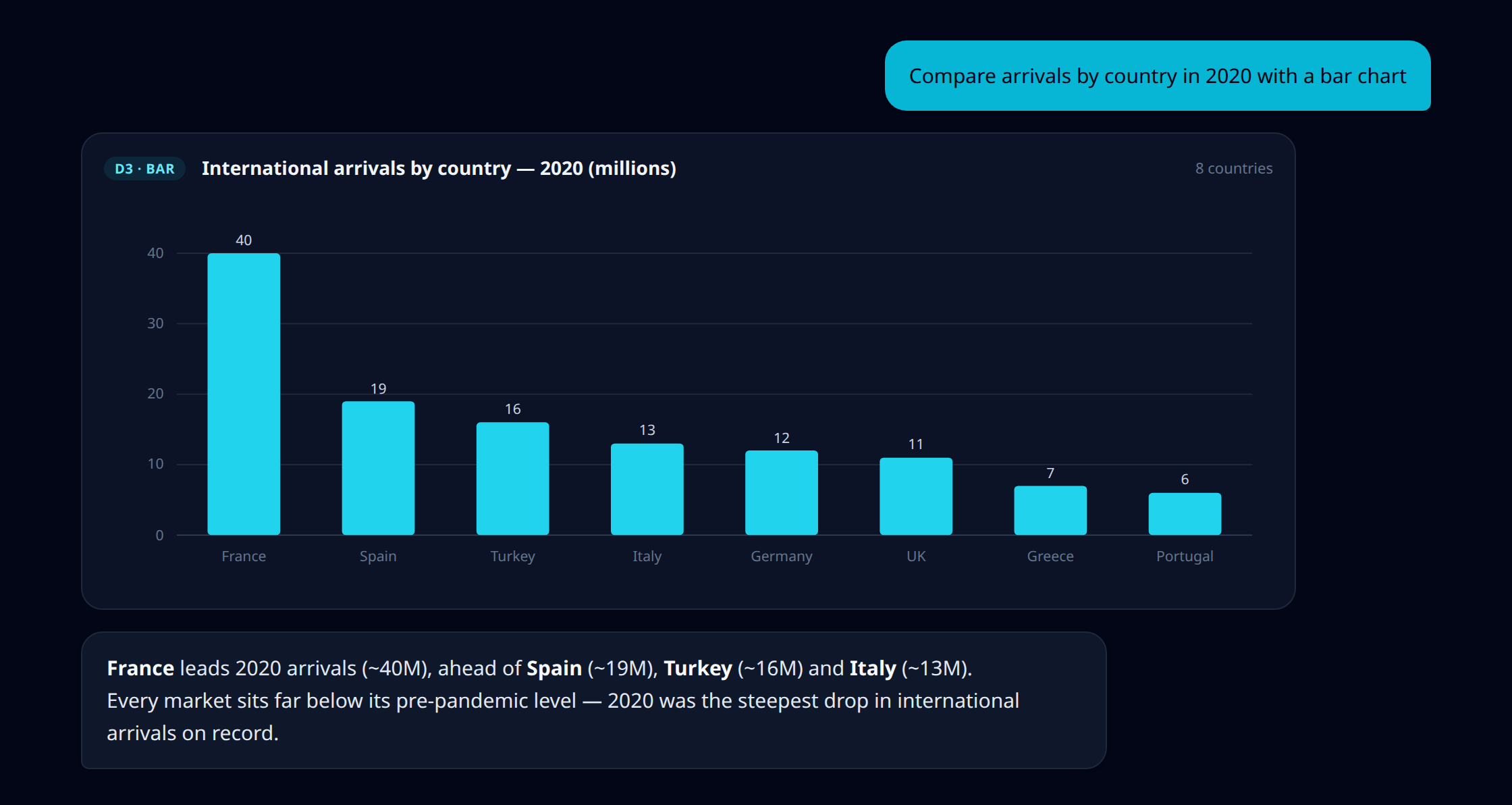
Ask in English; Chakx finds the dataflow, loads a filtered slice and answers with a chart — and the SQL.
How it works
Grounded data architecture
Catalogue lookup
Calls akx.search / akx.dataflows / akx.dimensions. Returns real IDs, descriptions and endpoints — never invents names from memory.
Computed numbers
Executes read-only SQL via DuckDB against actual SXS parquet files. Figures come from execution and the live API, and cannot be fabricated.
Real codelists
akx.values resolves codes ↔ labels (REF_AREA=CH01 → “Zürich”), so filters use valid codes and never silently invalid ones.
Typed tool schemas
Strict input schemas constrain every tool call. Off-schema calls return structured errors for recovery rather than hallucination.
Enforced rules
INSTRUCTIONS.md forces discovery and code resolution via AKX tools only — making grounding the default path, not an afterthought.
Visible & auditable
Failed queries output visible errors. The app exposes the actual SQL and real dataflow IDs so answers can be source-checked.
Technical stack
Discover over MCP, compute in the browser
Client–server flow
Browser streams over SSE to /api/chat (TanStack Start). The server talks to the LLM (via OpenRouter) and to AKX over MCP; the heavy lifting happens in the browser.
Core tech & tools
Solid + TanStack; 4 MCP discovery tools (akx.*) and 10 client tools (sxs.availability|count…, duckdb.loadDataflow|query|chart|timeSeries…); live SXS parquet over SDMX v3; read-only SQL and D3 charts.
Observability & metrics
One record per LLM call: model/provider, TTFT, duration, tokens, cost, tools[{kind,name,duration,ok}] and outcome. A read API exposes latency p50/p95, cost and per-user/model/tool breakdowns.
Browser ── SSE ──►  /api/chat  (TanStack Start)
   │  ▲              ├─ OpenRouter ─►  LLM
   │  │              ├─ MCP client ─►  AKX /mcp  (4 tools)
   │  │              └─ requireUser ─► auth (OTP / OIDC)
   │  └── client tools (10) ─► DuckDB-WASM ─► SXS parquet
Chakx + Disco
Ask in English. Then explore like an analyst.
Chakx is the concierge — ask a question, it finds the shelf and hands you the exact volume. Disco is the reading room — browse the whole collection, work with the data, and set up a display for others.
- 01Find → explore
Chakx lands you on the exact slice; Disco is where you keep going — browse the full structure, change filters, check availability and save the view.
- 02Two audiences, one dataset
A business user asks in Chakx; an analyst opens the same dataflow in Disco. One shared engine, so the numbers agree.
- 03Breadth vs depth
Chakx answers “what data exists for my question?”. Disco answers “what is in this dataflow?” — every dimension, version, availability and export.
- 04A shared handoff
A Chakx answer — dataflow, filters and DuckDB query — maps onto a Disco explorer view, so the copilot’s first cut becomes your starting point.
- 05Trust either way
Chakx grounds every answer (AKX resolves, DuckDB executes, the SQL is shown); Disco lets you inspect the structures and constraints before you publish.
Give your users a data copilot
Answers with the evidence, grounded in real SDMX data — model-agnostic and production-ready.